
Workplace Hearing Protection: Why Custom Earplugs Are Often the Best Choice
Workplace noise is easy to underestimate. Machinery, power tools, construction equipment, manufacturing processes, engines and other loud operations may be part of an ordinary workday, but repeated exposure can gradually damage a worker’s hearing.
Noise-induced hearing loss often develops slowly. A worker may not notice a major change from one day to the next, even as their ability to hear certain frequencies begins to decline. Audiometric testing is important because it can identify early changes that workers may not recognize themselves. (CCOHS)
Once sound-induced hearing loss occurs, it cannot simply be reversed. Prevention is therefore one of the most important parts of any workplace health and safety program.
How Workplace Noise Affects Hearing
Sound is measured in A-weighted decibels, commonly written as dBA. The potential risk depends on both the volume of the sound and the amount of time a worker is exposed to it.
A relatively loud noise may be acceptable for a very short period, while a lower noise level can become hazardous when exposure continues throughout an entire shift. In most Canadian jurisdictions, the occupational exposure criterion is 85 dBA over an eight-hour workday. Federally regulated workplaces generally use an eight-hour limit of 87 dBA. (CCOHS)
Alberta’s occupational health and safety rules establish an exposure limit of 85 dBA over eight hours. As noise levels increase, the permitted exposure time drops quickly. Alberta’s schedule allows four hours at 88 dBA, two hours at 91 dBA, one hour at 94 dBA and only 15 minutes at 100 dBA. (Search OHS Laws)
This means that even a task that takes up only part of a shift can create a serious hearing risk when the equipment is sufficiently loud.
Workers exposed to harmful noise may experience permanent hearing loss, tinnitus or difficulty understanding speech, particularly in environments with background sound. Excessive workplace noise may also interfere with communication and make it harder to hear alarms, approaching equipment or verbal warnings. Health Canada has noted that occupational noise can contribute to workplace accidents when warning sounds are missed. (Canada)
Hearing Protection Is Part of a Larger Noise-Control Plan
Earplugs and earmuffs are important, but they should not be the only response to workplace noise.
Employers should first determine where the noise is coming from and whether it can be reduced. This can involve replacing loud equipment, maintaining machinery, installing sound barriers, enclosing noisy processes, increasing distance from the noise source or changing the way a task is performed.
Administrative controls can also reduce exposure. Workers may rotate between tasks, spend less time in noisy areas or schedule particularly loud work when fewer people are present.
Hearing protection becomes necessary when these controls cannot reduce exposure enough on their own. CCOHS states that hearing protectors should be worn when exposure is close to or above the applicable occupational limit. The device must also be selected properly and worn correctly to provide meaningful protection. (CCOHS)
In Alberta, employers must conduct a noise exposure assessment when workers may be exposed above 82 dBA. When excess noise is confirmed, the employer must implement a noise-management program that addresses education, noise controls, hearing-protection selection, training, warning signs and audiometric testing. (Search OHS Laws)
Common Types of Workplace Hearing Protection
Disposable foam earplugs are widely used because they are inexpensive and easy to distribute. When inserted properly, a suitable foam plug can provide strong noise reduction. However, the worker must compress the plug, position it deeply enough and allow it to expand inside the ear canal.
Reusable premoulded plugs are quicker to insert and can be cleaned between uses. They are usually available in several sizes, but they are still manufactured for a general range of ears rather than one individual worker.
Earmuffs fit over the entire outer ear. They are easy to see, simple to remove and convenient when noise exposure is intermittent. CCOHS notes that earmuffs may be preferable when workers regularly move between quiet and noisy areas because repeatedly removing and reinserting earplugs can be inconvenient. (CCOHS)
Some high-noise environments require dual protection, with earplugs worn underneath earmuffs. The correct choice depends on the measured noise level, the work being performed, other protective equipment and the amount of protection the individual worker actually receives.
Why Custom Hearing Plugs Are Often the Best Long-Term Option
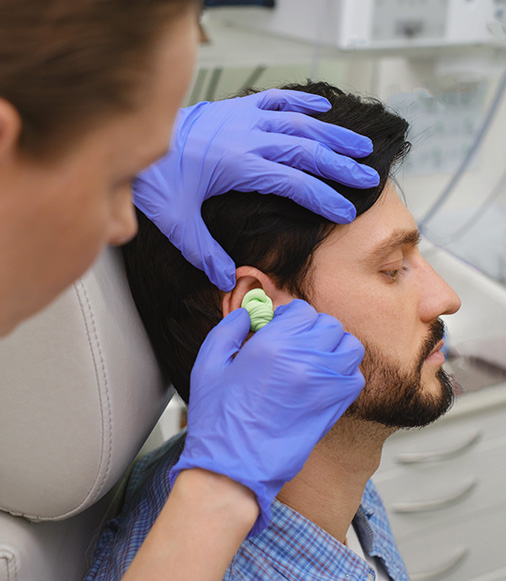
Custom hearing plugs are made from impressions or digital scans of an individual worker’s ears. Instead of relying on a generic small, medium or large size, each plug is shaped to match the person’s ear canal.
This personalized fit is one of their greatest advantages.
A hearing protector only works when it creates an effective seal. Disposable or standard reusable plugs may work very well for some people, but workers can struggle to insert them consistently. Ear canals also differ in size and shape, and one ear may not be identical to the other.
A professionally fitted custom plug provides a repeatable position. The worker can generally insert it in the same way each time rather than attempting to judge whether a foam plug has expanded correctly.
Custom hearing plugs can also be more comfortable during long shifts. Discomfort is not a minor issue because workers are less likely to wear hearing protection consistently when it causes pressure, irritation or soreness. A device that remains comfortable for several hours is more likely to stay in place throughout the worker’s exposure.
They may also be easier to manage in jobs where gloves, dirty hands or frequent movement make rolling and inserting disposable foam plugs impractical. Custom plugs can be removed, cleaned and reused according to the provider’s instructions.
Although custom plugs cost more initially, their reusable design may make them a practical long-term investment for workers who require hearing protection every day. Employers may also spend less time continually replacing disposable products.
Protection Without Blocking More Sound Than Necessary
The goal of hearing protection is not always to block the greatest possible amount of sound. It is to reduce exposure to a safer level while allowing the worker to remain aware of important sounds.
Too little protection leaves the worker exposed. Excessive protection can create other problems by making communication, alarms or changes in machinery harder to hear.
Custom earplugs can be produced with different filters or attenuation options for particular environments. Depending on the design, they may reduce harmful sound while preserving more natural speech and environmental awareness than a basic solid plug.
This can be valuable in construction, manufacturing, transportation, live entertainment and other workplaces where workers must communicate while remaining protected.
However, no employer should assume that a product provides the same result for every person. NIOSH explains that fit-testing systems measure the noise reduction an individual actually achieves while wearing a hearing-protection device. Fit testing can identify whether the device is appropriate and whether the worker is inserting it correctly. (CDC)
Custom Earplugs Still Require Proper Care
Custom does not mean maintenance-free.
Workers should follow the manufacturer’s directions for cleaning, storage and inspection. Earwax, dirt and moisture can affect hygiene and performance. Damaged, hardened or poorly fitting plugs should be replaced.
A person’s ears can also change over time. Significant weight changes, changes to the ear canal or deterioration of the material may affect the seal. Workers should have the plugs checked when they no longer feel secure or when their measured protection changes.
Training remains essential. Every worker should understand how to insert and remove the plugs, how to recognize a proper fit and when additional protection may be required.
Building a Stronger Hearing-Conservation Program
The best workplace hearing program combines several measures rather than relying on a box of disposable plugs near the entrance to a noisy area.
Employers should assess sound levels, reduce noise at its source, select suitable protection, provide worker training and arrange hearing testing where required. Employees should be encouraged to report discomfort, damaged equipment, communication problems or concerns about whether their protection fits correctly.
For workers exposed to noise every day, custom hearing plugs are often the strongest overall option because they combine a personalized fit, repeatable insertion, long-term comfort and reusable construction. They are not automatically the correct device for every task, but when they are selected using a proper noise assessment and verified for fit, they can make consistent workplace hearing protection much easier.
Protecting hearing requires action before a worker notices a problem. By the time conversations become difficult or tinnitus appears, permanent damage may already have occurred. Investing in effective, comfortable hearing protection today can help workers preserve their hearing for the rest of their careers.